
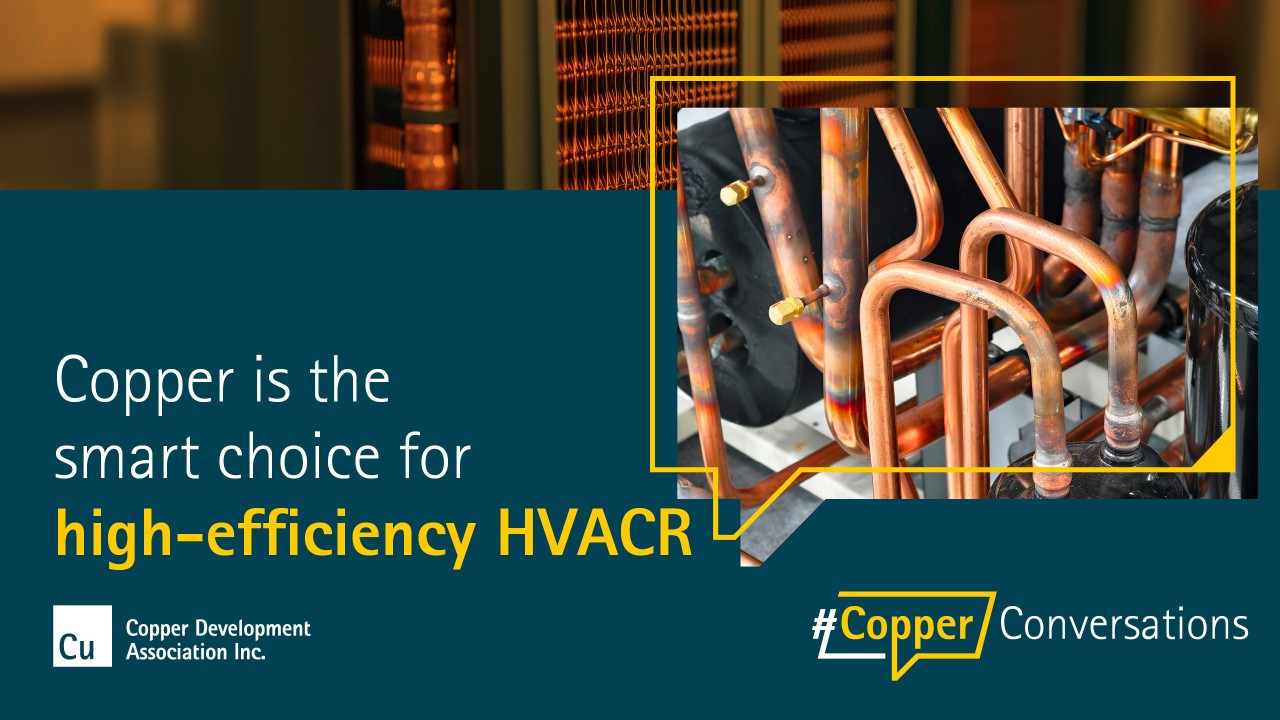
Copper Is the Smart Choice for High-Efficiency HVACR
Part of the Copper Conversations Campaign – October 2025
Author: Marcus Elmer (CDA Vice President)
From the first modern air conditioner designed by Willis Carrier to today’s digitally connected, high-efficiency systems, copper has been central to how we heat, cool, and condition the spaces where we live and work. Its inherent combination of exceptional thermal conductivity, mechanical strength, natural corrosion resistance, and full recyclability has made it a trusted, constant material across every generation of HVACR design, ensuring system integrity and performance over decades.
Rising demand, evolving requirements, and technical challenges
Global demand for heating and cooling continues to surge, driven by urbanization, increasing climate awareness, and the growing adoption of electrified comfort systems such as heat pumps. This growth is accelerating rapidly, with the International Energy Agency reporting that energy use for space cooling has more than tripled since 1990 and projected to climb sharply through 2050, putting pressure on electrical grids and energy systems.
At the same time, OEMs are designing systems within tighter envelopes while navigating increasingly rigorous energy codes, including higher minimum SEER (Seasonal Energy Efficiency Ratio) and IEER (Integrated Energy Efficiency Ratio) mandates. Furthermore, the mandatory transition to A2L and lower-GWP (Global Warming Potential) refrigerants introduces new operational constraints, such as flammability considerations and the need for zero-permeability containment.
Each of these challenges places emphasis on core material performance, where copper’s properties become not just an advantage, but a necessity for reliable, long-term operation.
Copper’s functional foundation and innovation
Copper’s role in HVACR is foundational and multidimensional. It is the core of the system, ensuring efficiency across thermal components, power delivery, motors, and electronic controls.
In heat exchangers and coils, copper’s superior thermal conductivity enables rapid energy transfer, which is necessary for meeting stringent energy-efficiency standards in compact designs. Its strength and formability allow manufacturers to implement thinner walls and innovative, small-diameter designs without compromising pressure integrity or safety over the equipment’s lifetime.
A critical advancement is the use of smaller-diameter, inner-grooved copper tubes. These products, typically ranging from 5 to 7 millimeters, have demonstrated up to 20 percent higher local heat-transfer co-efficient compared with traditional 9.5-millimeter smooth tubes.
The geometry of these microgrooved designs significantly increases the surface-area-to-volume ratio, facilitating superior refrigerant mixing, more effective heat exchange, and simultaneous reduction of airside pressure drop.
For OEMs, this is a triple-win: it provides a proven, manufacturable pathway to achieving higher efficiencies while allowing for coil design consolidation, translating directly into material savings, reduced unit size, and lower overall system weight − all crucial factors for easier installation and reduced shipping costs.
Copper and smart electrification
The era of smart buildings and high-efficiency heat pumps is defined by precise electronic control, and these systems are inherently copper-dependent.
Modern HVACR relies heavily on Variable Refrigerant Flow (VRF) and inverter-driven compressor technology. These systems function by precisely adjusting motor speed to match cooling or heating load, which requires complex power electronics and sophisticated motors. Copper is essential here for two reasons:
- High-Efficiency Motor Windings: Copper's low electrical resistivity ensures minimal energy loss in the motor windings, maximizing the efficiency of the inverter-driven compressors that are the central mechanism of VRF technology.
- Power Electronics and Controls: The complex inverter boards and high-frequency power circuits that regulate motor speed rely on copper traces, busbars, and robust wiring for efficient heat dissipation and low impedance power delivery − elements that directly influence the system's IEER rating and operational longevity.
As systems become more digitally integrated, copper wiring continues to link sensors, controls, and communication buses that manage comfort and provide the real-time data necessary for predictive maintenance and peak efficiency.
Supply security and circular sustainability
Copper is now included on the 2025 USGS draft Critical Minerals List - a designation that officially recognizes its essential and non-substitutable role in the energy transition and confirms the strategic strength of domestic supply chains. This designation supports investment in U.S. mining, refining, and recycling, securing a vital stable supply chain for domestic manufacturers.
The U.S. already benefits from abundant reserves and a mature recycling network. Approximately one-third of domestic copper demand is currently met through recycled material, and the infrastructure to expand this figure is robustly in place. This supply security ensures manufacturers can meet the long-term demand for HVACR equipment without overreliance on unstable global sources, supporting both growth and circular sustainability goals.
CDA: A partner behind the performance
Since 1962, the Copper Development Association (CDA) has worked alongside manufacturers, OEMs, and engineers to advance copper applications and standards across all sectors, including HVACR.
CDA provides technical expertise, design guidance, and market insights that help the industry build better, more efficient systems. From compliance verification to material selection, CDA’s goal is simple: to empower the professionals designing the systems that move our air, water, and energy.
Summary
The HVACR industry stands at the intersection of comfort, climate, and efficiency, tasked with electrifying its base while reducing its carbon footprint. Every system depends on materials that perform under pressure, adapt to new technologies, and provide reliable service for decades.
Copper continues to meet that challenge − efficient, reliable, recyclable, and ready to support the next generation of sustainable HVACR design.